

In my daily routine accompanying investors in the acquisition of vacation homes in Orlando, transferring funds from abroad to the United States has ceased to be merely an operational step. This operation reveals nuances far beyond the simple sending of amounts, especially when it comes to large volumes, strategic decisions, and evolving tax legislation. In 2026, international fund transfers became a recurring theme among high-income families, investors, and even those seeking diversification outside Brazil. I will guide you through the main paths, obstacles, and smart choices, bringing real examples and a critical perspective based on my experience of 58+ transactions in Magic Village.
The scenario of 2026: capital flow, new rules, and the timing factor
Few people understand, as we at Premier Sotheby's International Realty do, that transferring international funds requires more than just choosing a currency exchange broker. The flow of dollars changed significantly in 2025 and 2026, and opportunities and risks migrated along with it. According to coverage by Agência Brasil, Brazil experienced the second-largest net outflow of dollars since 1982, with a negative foreign exchange flow of over US$33 billion just in 2025. The financial channel, responsible for helping investors internationalize their assets, pulled this statistic down.
This impacts more than the headlines suggest. When many seek currency security, unpredictable pressures arise on the value of the dollar, requiring heightened attention to the timing of the transfer. And, as I have witnessed in various operations, this detail makes a difference in the net result of the property purchase.
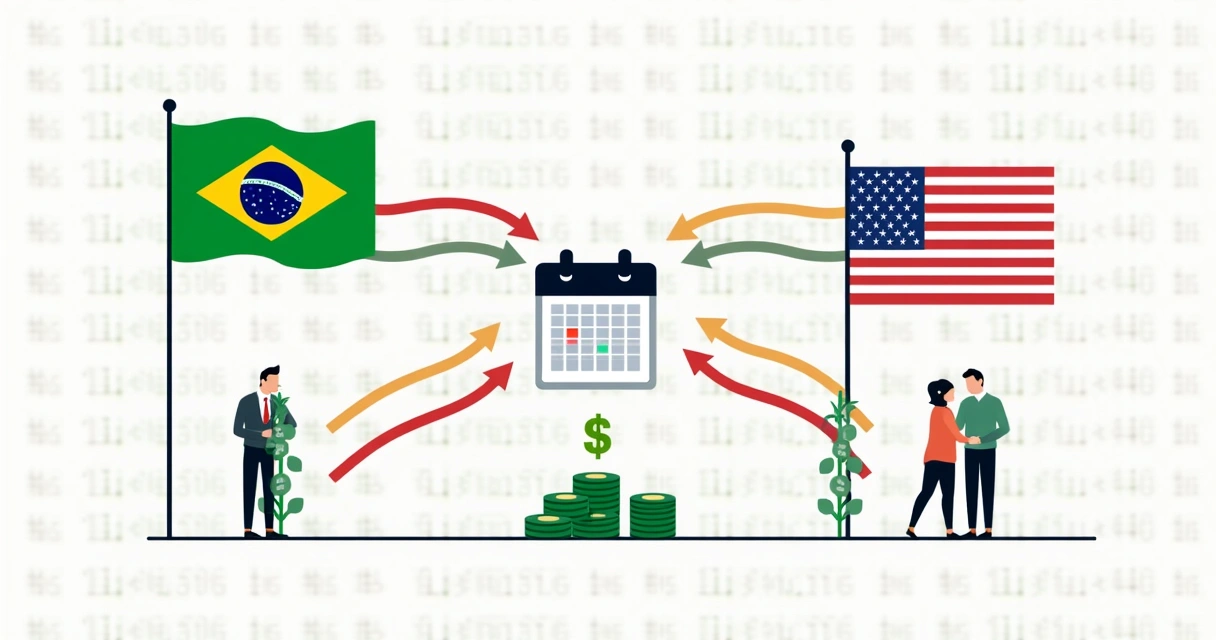
What are the paths for transferring international funds?
When talking to various investors, I realize that few know how to calculate the real impact of costs and delays from different sending channels. The options go beyond traditional banks, encompassing fintechs, specialized brokers, and customized structures for large amounts. I will explain each possibility that I use in my advisory projects, evaluating advantages, risks, and when to recommend them.
Traditional banks: security with slowness and explicit costs
Transferring funds through banks is, for many Brazilians, the automatic option. International SWIFT is considered secure; however, it tends to be one of the slowest and most expensive alternatives.
- High administrative costs (fixed fees and variation in exchange spread)
- Timeframe of 1 to 5 business days until effective receipt in the USA
- Rigid compliance processes, which may require extensive proof of origin
- Subject to future dollar variation and possible retention for clarification with Bacen
I have seen clients arrive late at closing by relying solely on this option, for example, in sales in Magic Village. In the current context, I use traditional banks only when there is no option, or for amounts that require robust institutional compliance.
Currency brokers: agility, personalization, and variation in service
Specialized brokers gained prominence from 2023 onwards. They serve a significant volume of investors, offer more competitive spreads than banks, and customize operations for those sending medium or large volumes.
- Agility in the process: sending in a few hours to up to two business days
- More favorable exchange rates, especially for transfers above US$50,000
- Dedicated customer service team, with agility for adjustments and documentation
- Currency hedge offers to lock in the dollar rate
However, I have seen differences of almost R$0.10 between brokers for the same volume transferred on the same day, so it is essential to analyze not only the spread but also the reputation and service capacity. And it is at this point that I guide the client, comparing proposals and centralizing communication.
Fintechs and digital platforms: immediate practicality, limits, and insecurity for large volumes
Fintechs like Wise, Remessa Online, and similar services have broken the hegemony of traditional institutions, offering good services for families and small remittances.
- 100% digital and intuitive operation, simplifying the process for beginners
- Lower fees for small transfers
- Low monthly limits, requiring profile upgrades to transfer larger amounts
- Possible compliance challenges and blocks when exceeding a certain value
When it comes to amounts of US$30,000, US$50,000, or more, I usually hesitate to recommend these isolated solutions without professional oversight. Scalability, robustness, and compliance control are not always on par with premium brokers, and this detail can be costly for those who do not follow experienced guidance.
Customized structures: trusts, companies, and asset strategies
Not infrequently, with ultra-high-net-worth families, we design tailored solutions, often using trusts, offshore holdings, or corporate structures. Such methods require sophisticated accounting and legal advice in both countries, bringing advantages not only in shielding but also in tax and succession planning.
These structures enhance security but only make sense with multi-million dollar volumes. In the advisory context, as I serve through Premier Sotheby’s, it is at this point that our team's differential emerges, protecting families from irreversible mistakes and mitigating surprises with the IRS and Receita Federal.
Typical obstacles in 2026: limits, bureaucracy, and volatility
Transferring funds has never been as scrutinized as it is now. In 2026, I see three main obstacles arising in international transactions:
- Increasing bureaucracy and continuous scrutiny of origins and purposes
- Daily currency volatility, impacting the final value received
- Transfer limits and new documentation requirements due to PLD/FT (Prevention of Money Laundering and Terrorism Financing)
According to a report from Portal Plox, the import tax on international shipments alone generated a record revenue of R$5 billion for the Brazilian government in 2025.

This demonstrates that control over currency exchanges with abroad has never been so strict, and consequently, real estate transfers, even legal ones, do not escape scrutiny. The compliance bias, previously restricted to suspicious operations, is now a rule for any relevant sending.
The role of timing: currency volatility as a real risk
I have seen clients who ignored this risk lose large amounts due to fluctuations in a matter of hours. According to news from Rondônia Dinâmica, Brazil's international reserves remain a buffer against volatility, but do not nullify the ups and downs of currencies in day-to-day transactions. Those who do not monitor the timing of the transfer may end up paying dearly or fail to secure liquidity to close a deal in Orlando.
It is at this point that strategic advisory makes a difference. I always monitor the exchange rate, guide my clients, and compare proposals to determine not only the best channel but also the best moment for sending, aligning with our acquisition and closing strategies. Leaving this aspect to chance is unnecessarily exposing oneself.
Tax planning: what changes with the new legislation?
One of the major points of doubt in 2026 is the tax impact involved in the origin, sending, and destination of funds. The cross-referencing of data between tax systems is an established reality, and being proactive is the only safe way for sophisticated investors.
- The origin of the funds must be proven with robust documents: declarations, statements, purchase and sale contracts in Brazil, among others.
- In the income tax declaration, both in Brazil and the United States, the investor needs to report the remittances and the acquired assets.
- The transferred amount may be subject to IOF of up to 1.1% in Brazil, in addition to taxes on gains abroad, if applicable.
- At the closing of the property, payment may require legal structuring to avoid double taxation and future issues with the IRS.
I cite, for example, the behavior pattern of many Portuguese who send remittances to Brazil. According to an article from Veja, 68.5% of international remittances to Brazil come from Portugal, with an average transaction value of €244 and operations carried out several times a month per sender. The control and accountability to the tax authorities, strengthened by new regulations, guide serious and safe practices for both small and large remittances.
When I assist high-income Brazilian families, I always work alongside local accounting, aligning all these points even before sending the funds. This measure reduces risks, avoids blocks, and allows the investor to sleep peacefully.
Practical step-by-step to ensure a safe transfer in 2026
Deciding the path to transfer international funds in 2026 requires a method. I share the tested roadmap with my clients, refined after dozens of real estate closing operations in Orlando:
- Define the exact amount and purpose: If it is for real estate acquisition, all costs must be calculated, including closing fees, taxes, and exchange margins.
- Compare transfer channels: Simulate banks, brokers, and digital platforms, considering deadlines, fixed fees, spreads, and limits.
- Check limits and regulatory obligations: Check the annual and monthly limit of your CPF/CNPJ, any locks from Bacen, and the need for documentary justification.
- Gather reinforced documentation: Proof of origin of the money (contracts, statements), income tax declaration, proof of residence, property purchase contract, etc.
- Align with advisory and accounting: Consult a specialist to avoid exposure to double taxation or compliance issues; here, the differentials of those who have already closed dozens of transactions become evident.
- Choose the most appropriate exchange timing: Monitor the exchange rate, use hedges if necessary, and avoid transferring during peaks of volatility.
- Track the status and record all receipts: Save proofs, maintain a detailed history, and ensure that the amount arrives in full to the destination account, without unexpected withholdings or discounts.

This roadmap is practically experienced by those, like me, who provide advisory at Premier Sotheby’s for clients investing in the main resorts of Orlando, such as Magic Village Views, Yards, and premium communities. The success stories of our clients show that personalization makes a difference in the final execution, something available only to those who truly know the behind-the-scenes of the process, as I reported in recent accounts of the international recognition achieved in 2025.
Differentials of specialized advisory: why operating in the top 1% makes a difference
After so many years working at the top of the vacation home market in Orlando, it has become clear that the secret lies not only in fees or speed. The differential lies in secure, personalized execution and the proactive design of risks and solutions.
Having advisory is transforming risk into results in international transfers.
Other companies may promise lower costs, but few accumulate a robust history in closing high-end transactions, know the nuances of each sending channel, and can structure tax planning in both the Brazilian and American environments simultaneously. In sophisticated operations, like those I conduct in Magic Village or Windsor Cay, improvisation is costly—time, extra fees, stress, and even judicial blocks.
No wonder I have dealt with delicate cases where competitors left clients exposed to tax audits, critical delays, and even reversals of operations due to lack of compliance. Our process carries the perspective of someone who cares for the investment thesis and not just the transaction, as I present in my analysis for those investing abroad for the first time.
Real cases: lessons from those who have gone through the process
I like to bring concrete examples because they show what manuals do not teach. In 2026, I accompanied a family from Rio de Janeiro planning to invest US$700,000 in a property in Windsor Island. After simulating through three distinct channels:
- The traditional bank charged a fee of R$800 and a spread of almost 2%.
- The currency broker, negotiating by volume, reduced the spread to 1.25%, releasing the amount in two days.
- The fintech, even with a fee of only R$200, informed a maximum operational limit of US$50,000 per month, requiring a profile upgrade, which would delay the closing by ten business days.
We concluded the transfer via the broker, monitoring the dollar for three days until we reached the best rate. The client saved over R$14,000 in total, and we closed the property without any issues. This type of decision, based on data and practical experience, is common in my working model, unlike the market standard of most competitors.
Another example was that of a Colombian investor who tried to transfer funds via fintech and faced a block due to inconsistency in declaring the origin. The solution, in that case, involved accounting guidance and sending via a corporate structure, which not only enabled the transaction but also shielded against future scrutiny.
The impacts of the macroeconomic scenario on real estate transfers
The 2026 context is marked by global uncertainties: geopolitical conflicts impacting currencies, high American interest rates, and changes in the technology and real estate sectors, as I pointed out in my analysis of NeoCity in Orlando. At this time, Brazil's international reserves, even robust, do not prevent moments of stress, as shown by the current account deficit exceeding US$68 billion in 2025.
Therefore, there is no "perfect timing": each transaction must be designed respecting the objective, urgency, and macro scenario, with integrated safety margins in the budget. Anticipating movements, protecting liquidity until the purchase closes, is something I have learned to prioritize in vacation home transactions in Orlando.
Final precautions to avoid typical mistakes
After advising dozens of families and investors, I share some common traps to avoid:
- Transferring funds without consulting a specialist: the cheap option can be costly in volatile exchange rates and current requirements.
- Ignoring the currency contract: review each clause before signing and ensure that all costs are clear from the start.
- Leaving everything to the last minute: the international settlement period can frustrate deals, especially in the short-term rental segment, where good deals do not wait.
- Not comparing proposals: negotiating spread, fees, and timing is a practice that makes a real difference in the final amount received.
These practices are even more relevant if you have been inspired by the trend of appreciation in Orlando's premium markets and are already decided to invest. The differential of our advisory lies precisely in anticipating problems and eliminating differences that can cost thousands of dollars in each transfer.
If there is one thing I have learned in these years advising Brazilian, Latin, and American families in vacation homes in the United States, it is that each step of the journey deserves strategic attention. Transferring international funds may seem simple, but it is an art when seeking liquidity, security, and real returns.
If you want differentiated support, comparing on and off-market opportunities and executing each step of the transfers with the level of security and personalization that only those operating in the top 1% of the segment offer, contact me to understand how I can design your next international investment strategy.
Conclusion
In 2026, international fund transfer became even more strategic, marked by greater regulatory control, currency volatility, and demand for transparent tax planning. The experience of those who have already executed dozens of high-end operations ensures that each step, from the chosen channel to the timing of the remittance, is designed to protect your assets and maximize returns. The safe path goes through professional advisory, process personalization, and constant updates in light of changes in the global financial landscape.
Follow the upcoming content on the blog and also on my social media, as sharing experiences and effective strategies is what contributes most to concrete results in the international journey. If you seek confidence and differentiated execution in the purchase of your vacation home in Orlando, my experience at Premier Sotheby’s is at your disposal to turn your project into reality. Shall we talk?
Frequently asked questions about international fund transfer in 2026
What is international fund transfer?
International fund transfer consists of sending amounts from one country to another, using regulated channels such as banks, brokers, or fintechs, for various purposes, including real estate investment. In 2026, this process involves more steps, from choosing the channel to compliance and tax control, requiring attention to avoid financial losses or regulatory blocks.
How to make an international transfer in 2026?
The sending of international funds begins with choosing the channel (bank, broker, fintech), preparing the documentation of the source of funds, checking the limits allowed for CPF/CNPJ, and monitoring the exchange rate. I recommend consulting specialized advisory to compare conditions, avoid errors in fees and timing, and deliver all records requested by Bacen and Receita Federal.
What are the main obstacles in 2026?
The main obstacles in 2026 lie in increased fiscal control, greater bureaucracy to prove the source and purpose of funds, reduced limits for transfers in some channels, and greater currency volatility. Heightened attention in planning and executing the transaction is essential to avoid delays, fines, and tax surprises.
How much does it cost to transfer money abroad?
The cost of transferring money abroad varies depending on the chosen channel: traditional banks charge high fixed fees and high exchange spreads, brokers tend to be more flexible, and fintechs offer lower rates for small amounts. There is also IOF of up to 1.1% in Brazil, in addition to fees at the destination, depending on the structure used. Always simulate and compare costs before deciding.
Is it safe to send funds internationally?
It is safe to send funds internationally as long as the chosen channel is regulated, the source documentation is in order, and the process has professional oversight. Errors are rare when there is planning, but they can lead to blocks, delays, and even investigations if the procedure is not aligned with the current norms of 2026.